Saturday, May 26, 2012

Arriving in Chiavari, Italy


Giovannina writing-

Chiavari is a small city on the Italian Riviera that I  have been visiting since my first birthday.  It is situated between Rapallo and Sestri Levante with tons of other great little towns nearby.  Portofino and Cinque Terre are two of the best known spots, but there are many other favorites that our family loves to visit as well.


Woody and I will be staying here for three weeks with my parents in their apartment two blocks from the sea.  I am named after my Nona [Grandmother] Giovannina, who along with her husband, Nono Attilio, bought the apartment in the 1960s for their retirement. When Nona Giovannina passed away, the apartment went to my parents who now live here for at least six months a year, typically January through July.


With the beach just down the street, a lovely open air market nearby  and great restaurants within a couple of blocks, we rarely leave Chiavari.  But since it is still spring and the weather is a little "fresca", Woody and I decided to spend our first day in Italy by going for a short hike in the mountains just outside of town.


The old way of travel here was to walk, and the towns are designed around this mode of transportation.  Path ways through the towns and villages lead to trails to the next town and so on. Recently the local hiking club - Club Alpino Italiano (CAI) has been fixing up many of the trails so it is very easy to go from town to town. There are trails all through the mountains of Italy. If you wanted,  you could hike from Chiavari all the way to Switzerland or France, or even head south along the "Backbone of Italy", the Apennines Mountain Range, all the way to the "end of the boot."  

We left the apartment and with in minutes were in the mountains behind town, enjoying a bit of a work-out after spending the last couple of days on airplanes. Soon we found ourselves on a ridge looking down upon Chiavari whose white stone buildings shone in the sunlight and contrasted with the green hills that rose from the sea behind it. Though the air was cold, the sun was bright, and the ocean glowed a deep blue, highlighting the curved edges of the mountains.


As we traveled farther out of town, we encountered  farms that had been trellised for olive orchards and gardens. We passed over bridges hundreds of years old and walked by ancient homes, some abandoned and some still being lived in, mostly by the older population that has not left for the cities.


All the while, the deep blue sea glowed beneath us.


Sunday, May 20, 2012

New Dehli (almost)

All airports look the same, cool metal beams over head with large tinted windows and long couridors some times with flat escalators if they are more modern.  On our trip we have found our way in, out and around many airports. We estimate that in the last five months, we have spent almost three days of our lives (about 65 hours) in airports. The longest of these layovers was in New Dehli, India on our way from Bangkok to Milan.

When we originally bought our tickets for this trip, we planned to spend three days in New Delhi. But sometime in the middle of our stay in the Philippines, we decided to extend our time in Thailand, which meant only spending a day in New Delhi, 17 hours to be exact. We'd arrive at 9:00 am Sunday and fly out at 2:00 am Monday morning. We figured that would give us enough time to store our bags, catch a taxi and see some of the city, the Taj Mahal and maybe even grab some genuine Indian food for dinner.

However, when we checked into our flight in Bangkok we were informed that because we didn't have a visa for India, we could not leave the airport...for 17 hours. This was, to put it simply, a bummer. The thought of spending all day and half the night in an airport - in a country we've never visited and would love to see at least a little of - made us antsy and we were really upset at ourselves for not looking into the visa issue earlier.

That is, until we arrived in New Dehli and saw this sign.


The outdoor air temperature was 38 degrees celsius (100 degrees F) and the air pollution was so thick we couldn't see more than a mile outside the airport windows. We both agreed our first real visit to India could wait, at least until the monsoons cooled things down and cleared the air a bit.

Friday, May 18, 2012

Bangkok

Bangkok - The City of Angels


After a two hour ferry and six hour bus ride from Koh Tao, we arrived in Bangkok at 9 pm without a place to stay. The bus dropped us off at Khao San Road - aka backpacker central - and we wandered through the throngs of partiers and amid street vendors selling pad thai, fruit shakes, obscene t-shirts and tickets to the late night sex shows. Neon signs were glaring overhead like Vegas and we could hear at least three different bands, all playing American cover songs, mostly rock and roll, mostly from the '90s.

I watched our gear while Giovannina searched for a room. After 10 minutes she returned with a 700 Baht/night (about $23 USD) room with its own shower and air conditioning. It sounded like a great deal to us and we proceeded to check in for our final three nights in Thailand.
We had wanted to spend a couple of days in Bangkok to get more of a cultural experience, something lacking on Koh Tao. The cultural experience we were after was not the the one in front of us in the festive streets of Khao San Road, but in the Buddhist temples and monasteries around the city. So the next day we got up and headed out to explore this ancient city.

We found a temple about two blocks from our hotel and decided to wander the grounds for a bit. We were both struck by the contrast of a holy place in the midst of the city. All of the alters were open to the public and the paths between the shrines were clean and well-maintained. The offerings of food and drink that were left for the spirits were not touched by anyone, even those without shelter begging on the street corner.

 
We were approached by an off-duty police officer who told us about a promotion sponsored by the government in which foreigners could be driven around the city by tuk-tuk for only 20 Baht (about 60 cents). The tuk-tuk driver got coupons for bringing the tourists to state sponsored outlet stores and the tourists got to see the city and maybe do a little duty-free shopping. We had heard of scams like this from other travelers, but honestly it seemed like a decent way to see the city for pretty cheap. So we flagged down a tuk-tuk and headed out to explore the city. Our driver, Joe, was very kind, teaching us some basic Thai phrases and drove us to several different temples, including the Lucky Buddha - I love that name - and the Standing Buddha, which was over 40 m tall. He also took us to a suit shop and a jewelery store, both of which we strolled through quickly and politely exited. We were also able to book a tour of the Floating Market for the following day. Next, Joe took us to see the Black Buddha, but it was closed for prayers. While we waited a Thai man who claimed to live in the U.S. tried very hard - and spoke very loudly - to get us to buy jewelery at the state-run store and then sell it in the states for a 195% profit. This, we found odd and politely ignored him as best we could, wondering if this really was some sort of elaborate scam.

 
We got lunch at a great little food stand where Joe told us a bit about his life. He had worked many years as an engineer making very good money (>$1000 USD/month) but was laid off when the company went under. Now he drove tourists around town in a suped-up tricycle. We paid Joe the 20 Baht, for which he was very pleased and he dropped us off at the Royal Palace. If the whole thing was a scam, it seemed to work out well for everyone involved.
These are just a few of the many buildings in the compound


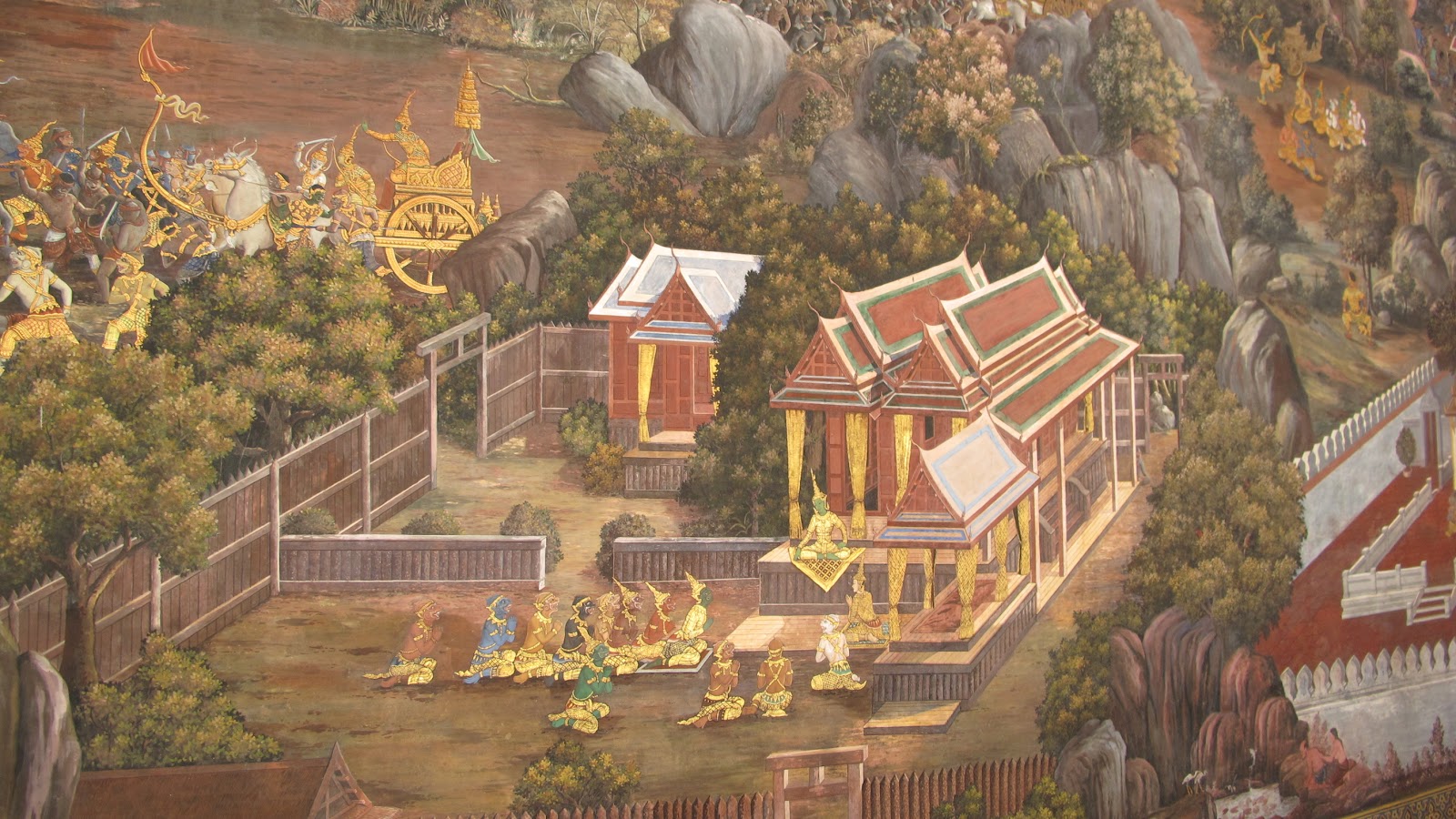
The Royal Palace was stunning. The architecture is a blend of traditional Thai and Cambodian designs, complete with demon statues, golden domes and vast murals depicting ancient stories. In these murals, the most important characters are painted in gold-leaf to make them visible even at night. The holiest part of the palace is the chamber for the Emerald Buddhas, which are actually jade, but are dressed in solid gold and diamonds. There are three of them (one for each season: Summer, Winter and Rainy) and the are rotated in a ceremony directed by the King. Pretty special.


We got to see the Summer Buddha and doused ourselves with lotus blossoms dipped in holy water to honor the event.


After the Royal Palace, we walked over to the Reclining Buddha, which is 45 m (about 150') long and about 10 m (30') tall. Massive. The statue has its own building, which was built around it after its construction over a century and a half ago. The still serenity of such a massive personnage was breathtaking. Although there were at least twenty tourists in the temple, it was almost silent.
 
We walked in awe down the length of the figure until we got to the feet, which tell another ancient story etched in mother of pearl.

At this point, it was late afternoon and the temperature was approaching 100 degrees. So we headed back to the cool of our hotel room to nap a bit and take a shower before heading out again to explore the Khao San Road night market.


The night market was like one huge festival happening in and amongst the city buildings. In alleys, on sidewalks and all over the street, vendors set up their wares and sold them to the throngs of passing tourists. For $1 USD each, we got a delicious curry and pad thai dinner. We then decided to have a snack of deep fried frogs, crickets and grasshoppers, which weren't nearly as bad as you might think, and looked a lot better than the cockroaches and maggots that were also available. We met an American doctor named Joe who had been working in Cambodian and bought us a beer in exchange for a deep-fried frog. We headed off to bed around 1 am. It seemed like the party was just starting, but we had to be up early for our trip to the floating market.


The Floating Market of Ratchaburi is about 90 minutes north of Bangkok and dates back to when the Chao Phraya River was the main means of transportation from the farms to the city and vice versa. Ratchaburi became a little trading post where vendors could sell their goods coming from or going to Bangkok. Now, everyone uses the highway, including the Floating Market vendors, who leave their boats in the canal and bring their goods via car and load up before the tourists arrive each day.
 
No fear, it's still really cool to watch vendors hawk their wares from a long-tailed boat. The town itself is built along a maze of canals, similar to Venice.

 
The houses all have boat launches so folks can leave from their yard and head down river.


We got back to Bangkok around 1 pm Saturday, took another air conditioning break in our room and headed out to the Chatuchak Weekend Market. This involved a 30 minute tuk-tuk ride across town by a mentally unbalanced driver who seemed to enjoy driving on both sides of the road at random intervals (He didn't get a tip.) The Weekend Market was huge, with vendors selling everything from pants and shirts to bedding and furniture, electronics to kids toys. The key here was to haggle, which we learned to enjoy. Often a price would start at 500 Baht, but if we were dilligent could get down to 300. This made us feel like we were getting a bargain, but probably we were just avoiding getting ripped off too bad.


We headed back to Khao San Road for our last night in Thailand and our last mango shake, which we will miss sorely. And so we ended our time in Thailand with more delicious, cheap food, loud, drunken backpackers and a hot, humid night.

To see more images from our time in Bangkok, check out our web albums for Bangkok and the Floating Market .

Friday, May 11, 2012

Underwater Koh Tao


We explored the underwater world with New Heaven Dive School and realized why this Island is so popular with new divers.  The water has spectacularly clear visibility and there are many good shallow dives around the Island perfect for beginners and for teaching classes.  The rock formations around the Island continue underwater which makes for some cool dive sites but there is not much live coral and the diversity of fish is relatively small so you can learn them /see them all within a dive or two.  There have been whale shark sightings lately in the area and yesterday many of the divers on our boat saw two but our group dropped in the wrong place and missed them - bummer. But it was still fun hanging out in the blue waiting and waiting....


The Koh Tao reefs are not nearly as diverse as the reefs on Apo Island and Moalboal in the Philippines. Sorry we do not have pictures but our camera has been on the fritz and we have taken it to the shop so we don't have any underwater photos from our dives.
 
We have gone snorkeling in a few of the bays near our hotel. The water here is between 86 - 92 degrees - it literally feels like a bathtub in some of the bays. Some bays are nice with good coral growth and fish life. And some are filled with dead corals covered in algae, a remnant of a coral bleaching event in 1998. In fact, the corals in many parts of the Gulf of Thailand have been suffering from several bleaching events in the last decade or so and many reefs have not recovered.


There is an organization called "Save Koh Tao" on the Island that has a marine conservation branch and the leader of the branch - Chad Scott - also runs a conservation program/class at New Haven Dive School. Many of the people we were diving with on the Island were taking this class, they were learning the species, surveying the reefs and working on building artificial reefs around the Island.  There are 9 artificial reefs that have been built around Koh Kao and one uses a low electrical current to encourage new coral growth. 

To see more images from Koh Tao, check out our Web Album.

Wednesday, May 9, 2012

Koh Tao - Thailand

It has been six days now that we have been in Thailand and I have not seen Woody this relaxed in months. When we started exploring options of places to go in Thailand we knew we didn't have that much time (only 10 days) and so we decided to pick only one place and stay there.  Woody was adamant that he wanted to do Yoga every day and I of course wanted to dive and hike.And after traveling for four months now, we have realized how nice it is to settle into a spot and enjoy it for a while. So we decided to make our home in Koh Tao for a week.


We landed in Bangkok on the 1st of may and on the 2nd we were on a bus to Chumphon Harbor and then a ferry to the Island of Koh Tao.  The community is a mix of foreigners who have settled here and opened up shops, local Thais running businesses and Burmese working for the Thais and the foreigners. The place is touristy yet very laid back. Resorts, restaurants and shops line the streets. You can get a massage or take classes on Thai massage or Thai cooking, or you can go cliff jumping (if you';re into that sort of thing.)  The SCUBA outfitters on Koh Tao certify more open water divers than anywhere else in the world (after Cairns, Australia), so during the day when all the divers are on the water, the white sand beaches are left empty for those not diving to enjoy.


Above is a photo of New Heaven, the SCUBA outfitter we have gone diving with. In addition, it has the most beautiful, open air Yoga studio on the top floor with a view out to the ocean.

All of the people we have met are wonderful, including our Yoga instructor, dive masters and the owner of the Dive shop. All foreigners who have come here to live and work - some have been here twenty years and some only a few months. It is very much like Hawaii to me (Giovannina writing), a beautiful tropical paradise that when people come they get sucked in and don't want to leave - a mixing pot of different cultures on our small Island in the Gulf of Thailand. I now understand why so many people have come to Thailand and have so many good things to say about it.

While Woody is more relaxed than I have seen him in months I am feeling a strange sense of anxiety that I can not quite put my finger on.  I love the small community we have immersed ourselves in, but I feel strangely like we are not in Thailand and that we are missing something important.  It all seems too easy and set up for us (visitors) - we see more French, Italian and British people as we walk down the streets than Thais. I went for a run yesterday morning and after getting myself thoroughly lost in the mountains behind our resort I started to feet better. We are also planning on spending a few days in Bangkok before we leave Thailand so I hope to get more of the cultural experience there.

To see more images from Koh Tao, check out our Web Album.


Thursday, May 3, 2012

Apo Island


On April 25th we finished working with Brian and headed out to Apo Island, a small volcanic island about 35 minutes off the coast of Dauin, the main SCUBA town around Dumaguete. Our host - and sort of boss - Brian, suggested we go to Apo and stay with his friend, Mario, and help with an Environmental Science class Mario  has been running for local high school students in the summer months when they were out of school. We felt this would be a great opportunity to connect with the community and to also get some R&R.

Mario picked us up in his bangka boat,  which doubles as his dive boat, and chatted with us the whole 35 minutes across the strait. He's a very friendly and dynamic guy. A native of Apo, he runs his own dive shop and guesthouse, as well as having a prominent voice in the community meetings - pushing for a more environmentally friendly Apo Island. He says he does it all for fun, and it shows. We stayed at his guesthouse and were delighted by the relaxing atmosphere, the ease of booking dive trips with him or his Dive Master, Macmac and we savored the delicious, fresh food, often fresh fish, caught that day and prepared by Theresa, the aunt of Mario's wife, Mila. Mila helped run the guesthouse along with their daughter Carla and their son- we're not kidding here - KarlMarx, who happens to be an excellent guitarist (not bad for a dead communist.)


We dove or snorkeled in the mornings and then either worked with the highschoolers or explored the island in the afternoon. Apo Island is a notable success story in marine conservation. Back in the 1980s, the reefs surrounding the island were severely over-fished and the locals decided to impose a moratorium, which was not very popular at the time. It took six (very tough) years of no fishing in designated zones to see a change, but the fish came back and now they the richest fishing grounds in the area, exporting much of their catch to other markets. They have continued to protect parts of the island, currently, there are two marine sanctuaries.  All of the waters are hook-and-line fishing only and only the people of Apo are aloud to fish around it. These standards have made a huge impact on the health of the reef. There are far more fish on Apo's reefs than at reefs either without fishing restrictions or where the rules aren't being enforced.

 
Sorry about the color on this photo, it is a bit washed out but this was a purple sponge with a huge purple frog fish in it. Can you find the frogfish?
 
The diving is phenomenal -we saw huge schools of jacks, big groupers - an almost rarity - large tuna patrolling the waters, turtles, frogfish and much more. After seeing the damage and garbage on other reefs around Dumaguete, it was great to see such a success story out on tiny Apo Island.


On our final day (April 30) Brian and Renee came over with some friends to see the island and do some diving. It felt great to meet up with some friends and share the great diving with folks we knew. We headed back to Dumaguete with everyone and went out to dinner that night at Hayahay. It was a feast, and we all filled our bellies with fresh fish and crab and washed it all down with cold San Miguels. It was a great ending to our time in the Philippines - good food, good friends and great diving.